
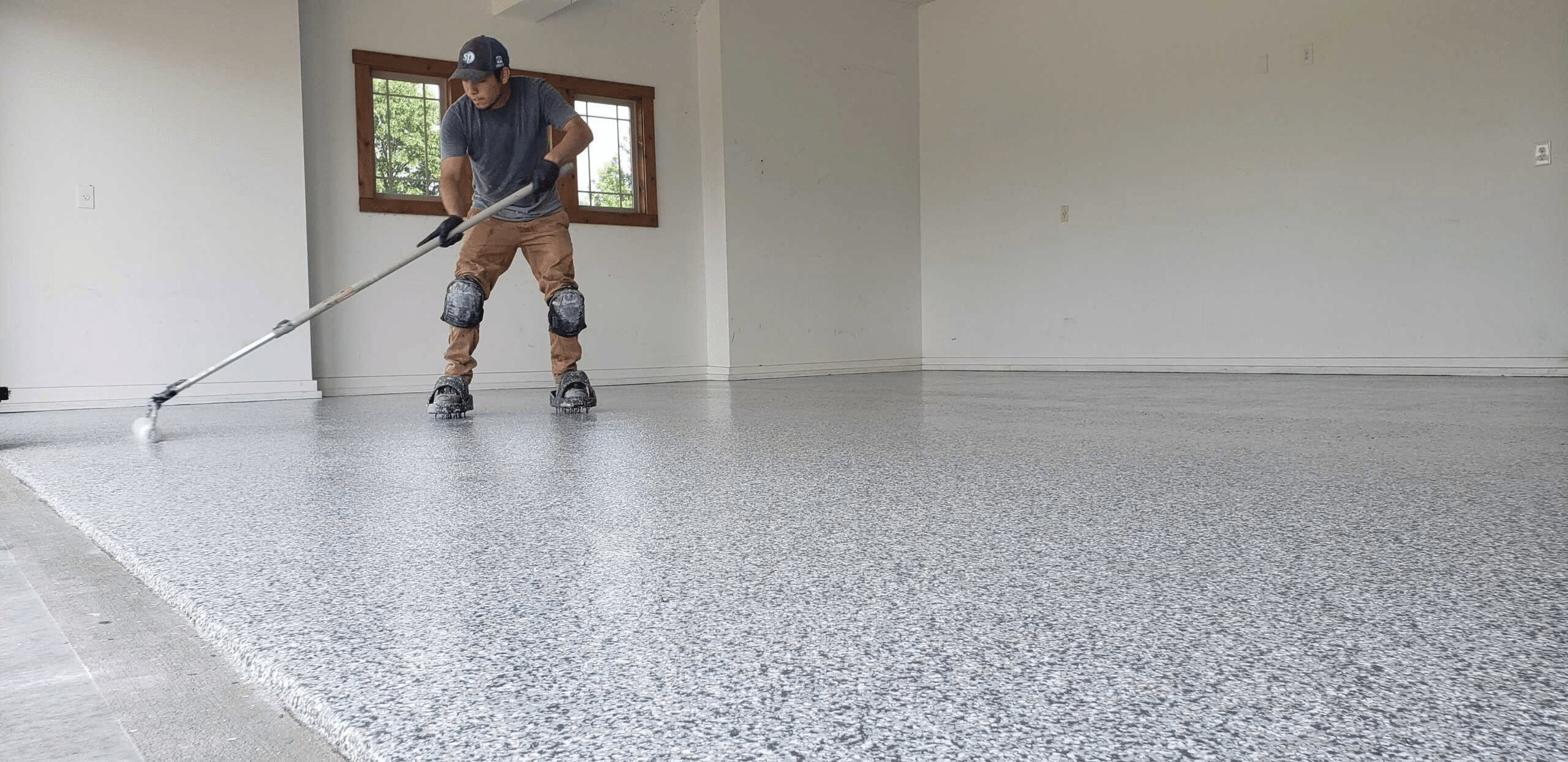
If you’ve started a polyaspartic garage floor coating comparison and ended up more confused than when you started, you’re not alone. One contractor calls it “polyurea.” Another says “polyaspartic.” A third pitches a “hybrid system.” The polyurea vs polyaspartic floor coating question trips up a lot of Kansas City homeowners because the terminology overlaps, the chemistry is real but rarely explained, and most marketing language skips straight to price without clearing anything up. Here’s what actually separates these two coatings, how they relate to each other, and why the best garage floor systems use both.
Key Takeaways
- Polyaspartic is technically a type of polyurea, so they share the same chemistry family
- Standard polyurea excels as a base coat but is not UV stable on its own
- Polyaspartic adds UV resistance, long-term gloss, and chemical resistance as a topcoat
- The strongest systems combine polyurea at the base and polyaspartic on top
- Kansas City’s freeze-thaw cycles and hot summers make the layered system especially important
- A 15-year warranty signals a contractor who stands behind their full system, not just the product
Polyurea vs Polyaspartic Floor Coating: What the Terms Actually Mean
When contractors use these two names, many homeowners assume they’re talking about two completely separate product categories. Polyurea and polyaspartic coatings are quite similar, and the main difference is that all polyaspartics are a polyurea, while not all polyureas are polyaspartic. They both come from the same polyurethane chemistry family, which is why the polyurea vs polyaspartic floor coating question gets murky fast.
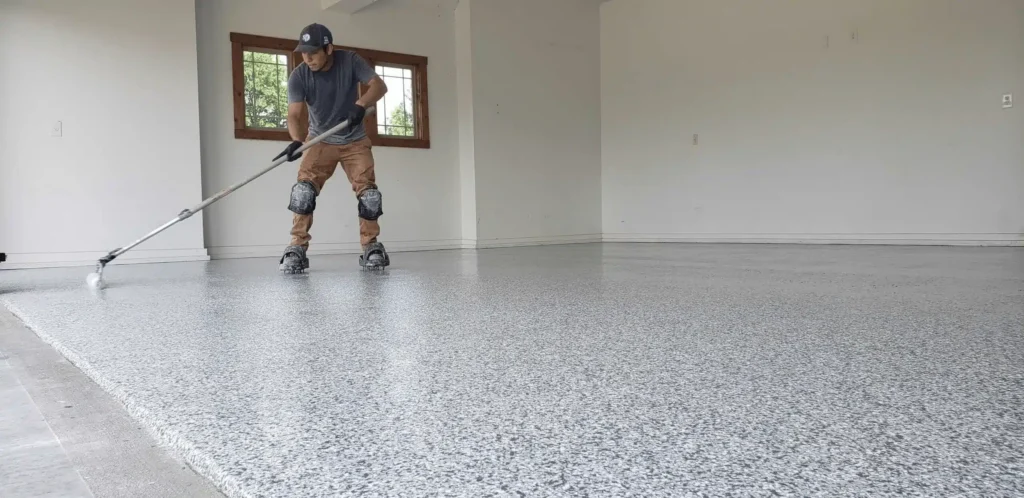
Polyurea is made from a chemical reaction between an isocyanate component and a resin blend, and this reaction happens extremely fast, so polyurea coatings cure much more quickly than other options like epoxy. That rapid cure and its ability to bond with moisture in the concrete slab are what make it such a strong base coat option.
Polyaspartics, on the other hand, are next-generation polyureas that have been modified to have stronger carbon bonds.
Polyaspartic is a modified polyurea designed to overcome the shortcomings of polyurea, including the time it takes for cure to take effect, polyaspartic takes a little longer to cure than polyurea, which means you can spread the coating at a more even pace without worrying it will dry too soon.
So when you’re working through a polyurea vs polyaspartic floor coating comparison, you’re not looking at two competing products. You’re looking at two members of the same family that are formulated to do different jobs in the same floor system.
Polyurea vs Polyaspartic Floor Coating: How Each Layer Performs
The clearest way to think about polyurea vs polyaspartic floor coating is by role: one goes down first, one goes down last, and both are doing something the other can’t do as well.
A polyurea base coat bonds tightly to the prepared concrete and adds flexibility at the slab level, while a polyaspartic layer then goes down as one of the final topcoats to raise UV stability, surface hardness, and long-term gloss retention.
That flexibility in the base layer matters in Kansas City. Summer temperatures regularly push into the 90s. Winter nights can drop well below freezing. Polyurea’s ability to expand and contract with temperature changes means it won’t crack or peel as easily as some other coatings. A rigid coating bonded to concrete that moves seasonally will fail, and usually faster than anyone expects.
The UV stability piece is where polyaspartic earns its role as the topcoat. Polyurea coatings made with aromatic compounds are vulnerable to discoloration when they’re exposed to sunlight.
Standard aromatic polyureas simply can’t handle UV exposure well, and over months and years, sunlight causes them to yellow, fade, and eventually degrade. Polyaspartic, with its aliphatic chemistry, solves that problem directly. Polyaspartic is more UV resistant than even UV-resistant polyurea coatings, and under sunlight, polyaspartic coatings do not change color, nor do they crack or weaken.
A pure polyurea floor without a polyaspartic topcoat sacrifices UV stability. A pure polyaspartic floor without a polyurea basecoat sacrifices adhesion and lifespan. That’s the part most marketing material leaves out.
What Cure Time Looks Like for Both Coatings
Cure time is one area where the polyurea vs polyaspartic floor coating comparison produces a real, practical difference.

Standard polyurea cures almost instantly and needs to be spray-applied by pros, while polyaspartic slows that reaction down to 20 to 60 minutes of working time, so it can be rolled on by hand. That longer working window makes the topcoat application more controlled and consistent.
For the homeowner, the practical result is that a professional polyurea and polyaspartic system typically wraps in a single day. The rapid curing time of polyaspartic means a garage can accommodate light foot traffic around 12 hours after a project is completed, and vehicle traffic can resume anywhere from 24 to 96 hours after.
One more advantage worth knowing: polyaspartic can be installed anywhere between 20 and 120 degrees Fahrenheit in terms of substrate temperature , which means a good contractor in the Kansas City area can work year-round and doesn’t need to turn you away in October or March. For more on timing, our seasonal installation guide for Kansas City walks through what to expect at different times of year.
Why Contractors Muddy the Water on Polyurea vs Polyaspartic Floor Coating
Here’s where the real confusion comes from. Some contractors market their product as simply “polyurea” without specifying whether it’s aromatic or aliphatic. Others use “polyaspartic” as a blanket term for the whole job even when the base coat is a standard aromatic polyurea. A few say “hybrid system” and then can’t explain what’s actually in each layer.
Remain cautious when hearing claims such as “our product is 5x stronger than epoxy”, the scope of resinous flooring products available today is far too complex for these types of generalities. That principle applies directly to any contractor who can’t walk you through their system layer by layer. According to Resinwerks, a coatings manufacturer, polyureas provide a lower-cost option but may not provide the same level of long-term performance as other materials, while polyaspartic chemistry incorporates advanced formulas and curing agents that provide for superior chemical resistance, UV stability, and impact resistance.
The questions worth asking any contractor before you sign anything:
- What product do you use for the base coat, and is it aromatic or aliphatic?
- Is the topcoat UV stable?
- How many coats are included, and what does each one do?
- What does the warranty actually cover, and for how long?
If a contractor deflects on any of these, that’s a signal worth taking seriously. Our post on garage floor coating warning signs most homeowners miss covers other red flags to watch for before you commit.
How Select Coatings Builds the Polyurea vs Polyaspartic Floor Coating System
Select Coatings, based in Lenexa and serving the Kansas City metro from Overland Park to Olathe to Lee’s Summit and Lawrence, applies a polyurea base coat that penetrates and bonds directly to the concrete. A polyurea base coat bonds tightly to the prepared concrete and adds flexibility at the slab level, and a polyaspartic layer then goes down as one of the final topcoats to raise UV stability, surface hardness, and long-term gloss retention, with this layered approach building durability from the slab upward, rather than relying on one coating to do everything, the products work together to manage impact, sunlight exposure, chemical contact, heavy tool use, and daily vehicle traffic.

The result is a floor that delivers a high-gloss finish, repels moisture, handles heat, resists scratches, chemicals, and stains, and stays color-stable because it’s 100% UV stable. That polyurea vs polyaspartic floor coating system is backed by a 15-year warranty, coverage on the finished floor, not just the material in the bucket.
Owner Ethan Knobloch started Select Coatings because Kansas City homeowners deserved a floor system installed and warranted by someone who stays accountable long after the job is done. If you’ve ever dealt with a floor that bubbled or peeled within a couple of years, you can read more about what causes that in our breakdown of concrete floor coating bubbles. The short answer: surface preparation and product selection working together from the start prevents it.
Running a Real Polyaspartic Garage Floor Coating Comparison Between Contractors
When you’re comparing quotes, a true polyaspartic garage floor coating comparison goes well beyond price per square foot. According to Legacy Industrial, chemistry plays a big role in coating performance, but the way the floor is prepared and installed often has even more influence on how long a system lasts.
Here’s what to look at side by side when you’re evaluating contractors:
Base coat product and method: Does the crew diamond-grind the concrete before application? A coating applied over an unprepared slab is building on a weak foundation regardless of how good the product is.
Topcoat UV stability: Ask specifically whether the topcoat is aliphatic. If the contractor isn’t sure, that’s a problem.
Warranty length and coverage: A 5-year and a 15-year warranty reflect very different levels of confidence in the system. Make sure the warranty covers adhesion failure, not just cosmetic issues.
Year-round capability: Good contractors in Kansas City don’t disappear when the temperature drops. A properly formulated polyaspartic system can go down across a wide temperature range when the right products and application methods are used.
For a broader look at how the coating type affects cost and long-term value, the post on epoxy vs polyaspartic cost breaks down where the price differences actually come from.
If you’re ready to stop sorting through competing claims and get a straight answer about what a polyurea vs polyaspartic floor coating system would look like on your specific garage, Select Coatings is available Monday through Friday from 9am to 5pm. Call +1 913 303 7276 to schedule a free estimate. The Select Coatings team serves homeowners throughout Overland Park, Olathe, Lenexa, Lee’s Summit, Lawrence, and the broader Kansas City metro with a layered coating system and a 15-year warranty that puts the proof on the floor.
