
Most Kansas City homeowners assume they need to wait until spring to coat their garage floor. The truth is more useful, and more complicated, than that.
The best time of year to install garage floor coating depends on which coating system you use, how your slab is behaving, and what you actually want to get out of the project. Some seasons are better for certain products. Some seasons offer real advantages that homeowners never consider.
This guide walks through each season honestly, explains the science behind the timing, and tells you what matters more than the calendar.
Key Takeaways
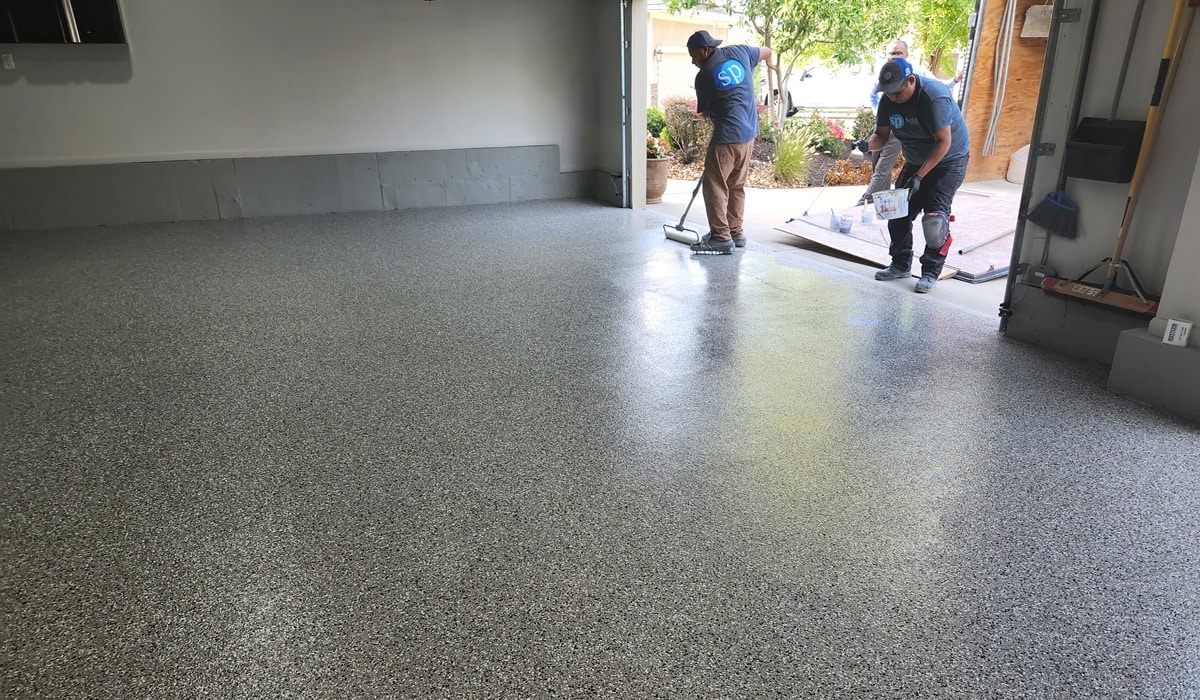
What the Best Time of Year to Install Garage Floor Coating Really Depends On
The season depends on the coating. Older epoxy systems have narrow temperature and humidity windows. Newer polyurea and polyaspartic systems do not.
Epoxy is a two-part chemical reaction that needs the concrete surface above 55°F and the air between 55 and 90°F. Outside that range, the cure gets unpredictable. You end up with a floor that sets too fast, sets too slow, or fails in ways you may not see for months.
One of the most common results of installing epoxy in the wrong conditions is visible bubbles. If you have ever seen a freshly coated garage floor develop raised bumps within weeks of installation, that is almost always what happened. The full breakdown of coating bubble causes comes down to moisture vapor movement, humidity, and temperature at install.
Polyurea and polyaspartic work differently. These systems can be installed at temperatures as low as -30°F and as high as 140°F, which is why seasoned installers use them year-round in climates like Kansas City.
What Temperature and Humidity Actually Do to Garage Floor Coatings
Temperature and humidity control how the coating cures, not just how fast it dries. Curing is a chemical reaction. If the reaction happens too quickly or too slowly, the finished floor is weaker than it should be.
Here is the simple version:
| Factor | Epoxy | Polyurea/Polyaspartic |
|---|---|---|
| Install temperature range | 55 to 90°F | -30°F to 140°F |
| Walk-on time | 24 to 72 hours | 12 to 24 hours |
| Park-on time | 5 to 7 days | 24 to 96 hours |
| Humidity sensitivity | High (bubbles form) | Moderate |
| Set time at install | About 25 minutes | 10 to 12 minutes |
Cold concrete slows epoxy curing and leaves the finish brittle. Hot conditions do the opposite, speeding the reaction so much that the surface cures before it bonds correctly to the slab.
Freeze-thaw stress is another factor that hits Kansas City concrete hard. According to the American Concrete Institute (ACI 201.1R-08), water expands by about 9% when it freezes, and repeated freeze-thaw action is one of the leading causes of concrete surface deterioration in cold climates.
That matters for timing because the concrete has to be sound before it gets coated.
Spring Installation: The Kansas City Snowmelt Problem
Spring feels like the obvious choice, but for Kansas City garages, it is not always the best one. The temperature range works for any coating type, and longer days make scheduling easier.
The catch is the slab itself. Kansas City winters are hard on concrete, and spring is when that damage shows up.
Spring install challenges:
- Snowmelt and salt residue soak into the slab through winter
- Moisture vapor movement stays high until the slab fully dries
- Slabs can hold water weeks after visible snow is gone
- Salt contamination on the surface can prevent proper coating adhesion
The best spring projects wait until the slab has been fully dried, tested for moisture, and cleaned of salt residue. Experienced Kansas City concrete coatings installers will test your slab before scheduling and may recommend waiting a few weeks if your garage saw heavy salt exposure.
Spring can work well. It just requires patience and proper slab evaluation first.
Summer Installation: Heat and Humidity Tradeoffs
Summer gives you the longest working days and the most consistent slab temperature. Kansas City summers average 90°F highs, which sits at the upper edge of epoxy’s range and well within polyurea’s range.
The tradeoff is humidity. Kansas City sits in a humid subtropical climate zone, and summer humidity can push moisture vapor transmission up through the slab faster than it can cure under the coating.
Summer installation notes:
- Early morning installs beat peak afternoon heat
- Polyaspartic cures faster in warm weather, which shortens the window installers have to broadcast decorative flakes
- Bare concrete exposed to direct sun can hit 120°F or more, which changes how resin wets out
- High humidity days should be avoided for epoxy systems
For most Kansas City homeowners, summer works if you pick a stable-weather week and the installer schedules around heat peaks. It is not the easiest season, but it is often the most convenient one for families planning around work and school schedules.
Fall Installation: Why Pros Often Pick This Window
Fall is the strongest single season for most garage floor coating projects in Kansas City. The reason is simple. You get moderate temperatures, lower humidity, and a coated slab ready to face winter salt and moisture.
Why fall works so well:
- Temperatures between 50 and 75°F land in every coating’s ideal range
- Lower humidity reduces moisture vapor issues during cure
- Slab is fully dried out from summer with minimal freeze-thaw damage
- Coating is in place before the first road salt hits your garage
Fall is also when you start to see surface damage that winter will accelerate. If your bare concrete shows small pits, flaking, or dust forming in tire paths, those are garage floor warning signs that the surface layer is breaking down.
Catching that damage in fall means you can coat over a stable slab before winter pushes the deterioration further into the concrete.
Winter Installation: The Off-Season Advantage
Winter is the season most homeowners never consider, and that is exactly why it can work in your favor. If you use polyurea or polyaspartic, the cold does not stop the install.
Winter install advantages:
- Shorter lead times because most customers wait for spring
- Off-season pricing from installers with open schedule slots
- Coated slab ready before the next salt season begins
- Better flexibility to pick your exact install date
Winter does require more setup. Your garage needs enough heat to keep slab temperatures stable during application, and the installer has to use products rated for cold-weather cure. Epoxy is off the table in January and February.
Polyurea and polyaspartic systems cure in 2 to 6 hours even at 40°F, which is why year-round concrete coating companies use them as the default product.
If your schedule is flexible and you want the best lead time, winter deserves a serious look.
What Matters More Than the Season You Pick
Season matters. Slab condition matters more. A dry, clean, properly prepped slab in February will outperform a soaked, salt-contaminated slab in April every time.
Three things matter more than the month:
- Moisture testing. Professional installers test slabs before coating using calcium chloride tests or RH probes.
- Surface profile. A concrete surface profile (CSP) of 3 to 4 is needed for coating adhesion, which only comes from mechanical grinding.
- Crack repair and slab reconstruction. Existing cracks and pits must be filled before the base coat goes down.
The single biggest predictor of long-term coating success is how well the concrete was prepared before the first drop of resin hit it. Proper surface preparation handles every factor that season alone cannot.
Kansas City climate data from the National Weather Service Kansas City office shows the average winter low at 22.4°F and average summer high at 90.1°F. That full range means whoever installs your coating has to match products and prep to the exact conditions at your slab on install day.
Making Your Timing Decision for a Kansas City Garage
The best time of year to install garage floor coating depends on what you care about most. Fall gives you the strongest all-around window, and winter gives you the best lead times. Spring works if your slab has dried, and summer works if the installer schedules around heat peaks.
Professional garage floor coating installation factors in your slab condition, the product system, and the Kansas City climate on install day. The right answer is rarely “any month is fine,” but it is also rarely “only one month works.”
Call us at 913-349-6689 for a FREE estimate today.
