
You get 2 quotes for your garage floor. One comes in at $3 per square foot. The other is $7. Both companies say their product is the better choice. You do not have enough information to know who is right.
The epoxy vs polyaspartic cost question comes up in almost every Kansas City garage floor conversation, and the confusion is understandable. Both products coat concrete. Both come in similar colors and finishes. But they are built from completely different chemistry, and that chemistry is what determines how long each product holds up in a Kansas City garage before you are back to square one.
Key Takeaways
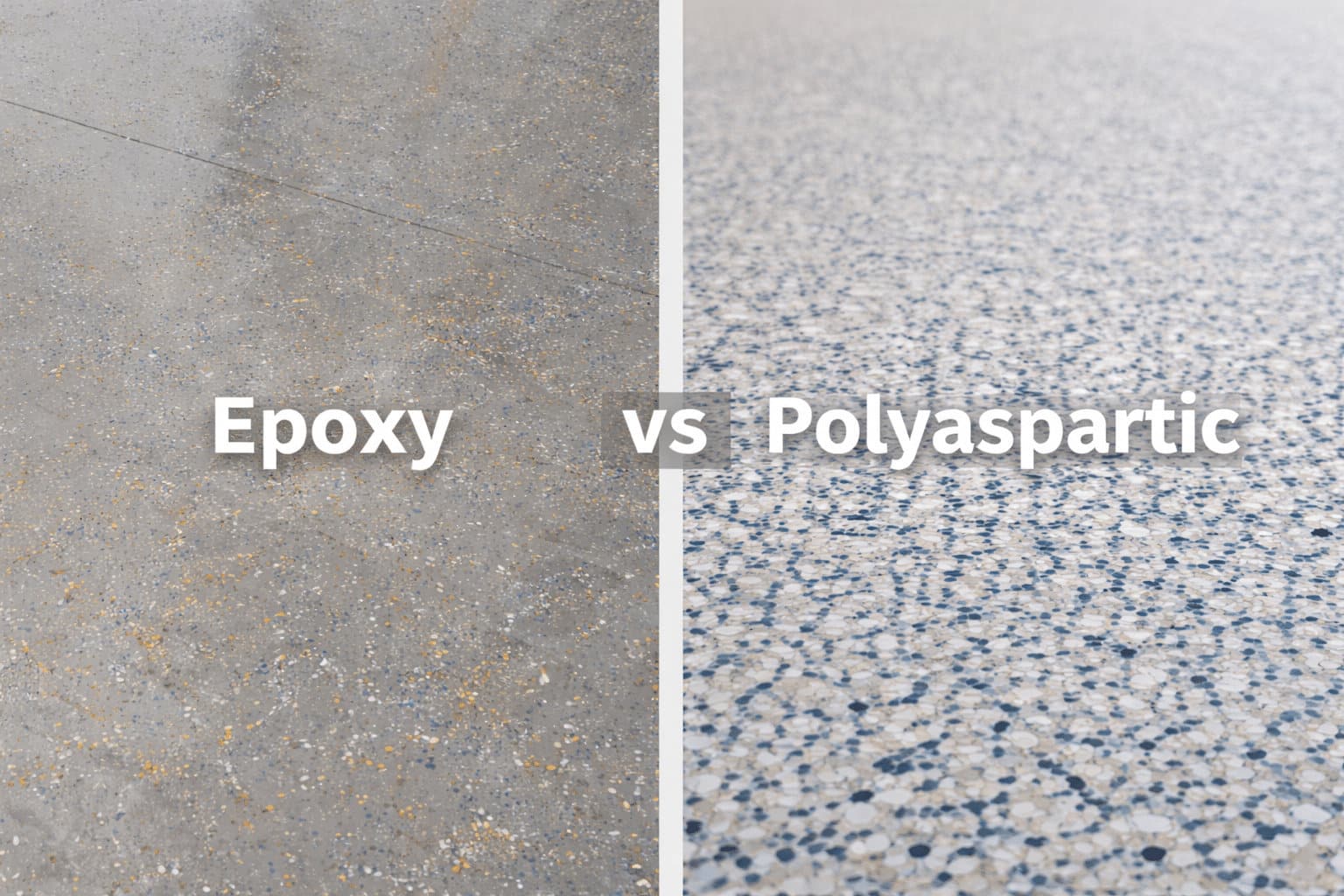
What Epoxy and Polyaspartic Actually Are
These are not 2 versions of the same product. They are chemically distinct systems that behave differently from the moment they are applied.
Epoxy is a 2-part system made of resin and hardener. When mixed, they react and cure into a rigid, hard film. That hardness gives epoxy its surface appeal but it also creates a limitation: the film does not flex. As concrete expands and contracts with temperature, a rigid epoxy film develops micro-cracks, and those cracks are where moisture, oils, and road salts enter and drive adhesion failure from underneath.
Polyaspartic coatings belong to the polyurea chemistry family. They cure through a different mechanism that produces a film with significantly more flexibility than epoxy at full cure. According to the Polyurea Development Association, polyurea-based systems demonstrate tensile strength and elongation properties that rigid epoxy films cannot match, which directly affects how long the coating stays bonded to concrete under real-world stress.
For a detailed side-by-side look at how these 2 systems compare across durability, cure time, and application requirements, the breakdown on polyurea vs epoxy coating systems covers the chemistry differences in plain terms.
The Upfront Cost Breakdown
Epoxy garage floor coatings in the Kansas City area typically run between $3 and $5 per square foot installed. Polyaspartic or polyurea-based systems typically run between $6 and $10 per square foot installed. On a standard 2-car garage of around 400 to 500 square feet, that difference can be $1,200 to $2,500 depending on the system and the condition of the concrete.
That gap is real and it is not padding. It reflects the actual cost of the product, the specialized application equipment, and the skilled labor required to apply each system correctly.
Polyaspartic application requires precise mixing and timing because the chemistry cures faster than epoxy. The installation crew needs to move accurately and efficiently. That speed benefits the homeowner since the floor is typically ready for light foot traffic within hours and full vehicle use within 24 hours, but it demands a more experienced application team than a basic epoxy pour.
Epoxy vs Polyaspartic Cost: The Per-Year Calculation
This is where the comparison changes significantly. Upfront cost is one number. Cost per year of usable floor life is a different number, and it is the more honest way to compare these 2 products.
A properly installed epoxy system in a Kansas City garage typically holds up for 3 to 5 years before noticeable degradation appears. Peeling at edges, yellowing from UV exposure, and adhesion failure around cracks are the most common patterns. Once that process starts, spot repair rarely works. Most homeowners end up with a full re-coat or a grind and recoat at additional cost.
A quality polyaspartic or polyurea system installed by trained applicators typically lasts 10 to 15 years under the same garage conditions. Select Coatings backs every installation with a 15-year workmanship warranty, which reflects actual product performance rather than a marketing estimate.
Divide the installation cost by the expected years of protection and the per-year cost of polyaspartic is often lower than epoxy, even though the upfront number is higher. That math is worth running before you accept any quote.
How Kansas City’s Climate Affects the Comparison
This is a factor general floor coating guides rarely address, and it matters specifically for homeowners across Overland Park, KS and the wider Kansas City Metro.
Kansas City experiences significant temperature swings, particularly in winter and early spring. Garage floors go through freeze-thaw cycles as temperatures drop below freezing at night and rise during the day. Concrete expands and contracts through those cycles, and a floor coating needs to move with the concrete or the bond starts to fail.
Epoxy’s rigid film handles that movement poorly. Research published by The Concrete Network documents how thermal cycling accelerates delamination in rigid epoxy systems on concrete substrates, particularly in climates with wide seasonal temperature variation. Kansas City sits squarely in that category.
Polyaspartic coatings accommodate that movement better due to their polyurea-based flexibility. The film stretches slightly with the concrete rather than pulling away from it, which is why the bond holds through multiple seasons in climates that stress rigid coatings.
UV Stability and What It Means for Your Floor’s Appearance
One of the most visible differences between epoxy and polyaspartic shows up after prolonged light exposure. Epoxy is not UV stable. Under direct or indirect sunlight, epoxy films yellow and chalk over time. For garage floors near windows, doors, or any natural light source, that discoloration can appear within 1 to 2 years. The yellowing is a cosmetic issue but it also signals UV degradation happening inside the coating itself.
Polyaspartic topcoats are formulated with UV stabilizers that resist that breakdown. The surface retains its color and clarity significantly longer under the same light exposure. For Kansas City homes with garages that receive morning or afternoon sun, this is a practical difference that affects both how the floor looks and how long it performs before showing wear.
Understanding what coating failure looks like before it becomes obvious is worth knowing. The guide on garage floor coating warning signs covers what early deterioration looks like and why catching it before it spreads changes your options significantly.
Installation Time and How It Affects Total Project Cost
Epoxy requires multiple cure stages. A base coat needs to fully cure before the topcoat goes on, and depending on temperature and humidity, that window can run 12 to 24 hours per coat. A complete epoxy installation typically takes 2 to 3 days before the garage is usable again.
Polyaspartic systems cure significantly faster. A complete polyurea base coat and polyaspartic topcoat system can typically be installed and ready for use within 1 day. That single-day installation reduces labor hours, eliminates the multi-day disruption to your household, and gets your garage back the same day crews leave.
For commercial spaces, that time difference carries even more weight. A day of closed operations in a mechanic bay, restaurant kitchen, or warehouse adds real cost beyond the coating price itself. The faster cure profile of polyaspartic is one of the primary reasons it has become standard in commercial floor coating applications.
For context on why garage floor coatings are a fundamentally different product category than floor paint, the comparison of concrete coating vs garage floor paint covers where paint falls short and what separates a performance coating from a surface-level product.
Reading Your Estimates After This
Now you can look at any 2 floor coating quotes and ask the right questions. What is the product chemistry? What is the cure time? What is the warranty and what does it actually cover? How long is the expected floor life under normal garage use in Kansas City’s climate?
A lower epoxy quote that requires a full replacement in 4 to 5 years at a similar cost is not a better deal. The math rarely works in epoxy’s favor once you run the full comparison against a 15-year polyaspartic system.
Select Coatings uses a commercial-grade polyurea base coat topped with a UV-stable polyaspartic clear coat on every residential and commercial project. It is a system designed for a 15-year floor life, not a 3-to-5-year maintenance cycle.
Reach out to our garage floor coating team and call us for a FREE estimate today. You can also get an instant online estimate in under 60 seconds before making any calls.
