

Homeowners ask me the same thing on almost every estimate: how long does it take to epoxy a garage floor, and how many days do I lose my garage? It is a fair question. Asking how long does it take to epoxy a garage floor is really a question about your life, not about chemistry. A garage floor coating installation takes over the one room most families walk through every day. You park there. You store there. Your kids drop their bikes there. So before I talk about coatings, I want to talk about your calendar. Most garages we handle through our garage coating services are finished in a single day. I will show you where that day goes and what stretches it.
Why “Epoxy” and “One Day” Get Confused
Here is something most contractors will not say out loud. Half the confusion about timelines comes from the word “epoxy” being used as a catch-all term. Old two-part epoxy hardens through a slow chemical reaction. It needs long gaps between coats and long waits before use. That is where the “your garage is gone for a week” stories come from.
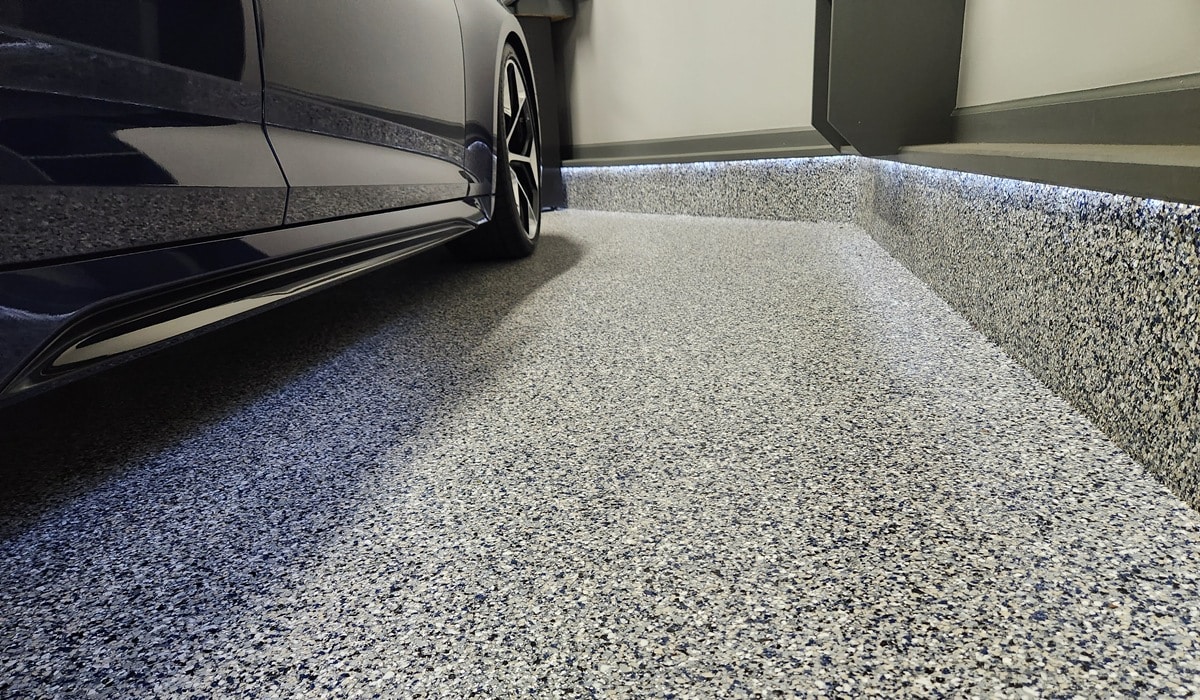
We install a polyurea base coat, a full flake broadcast, and a polyaspartic top coat. A polyurea garage floor system hardens fast enough that the crew can grind, coat, and finish in one visit. That is not a claim about being better. It is different chemistry on a different clock. Say you are pricing a garage floor coating installation and one bid says one day while another says five. The material choice is usually the reason.
What a One-Day Garage Floor Coating Installation Looks Like
Every project moves through the same sequence. We grind the slab, repair what is broken, lay the base coat, broadcast the flake, scrape and vacuum, then seal it with the polyaspartic top coat. The crew leaves the same evening on most residential garages. What matters more to you is when the room is yours again.
| Milestone | What it means | Timing |
|---|---|---|
| Crew arrives to crew leaves | Grinding, repair, base coat, flake, top coat | Most garages, one day |
| Larger or damaged slabs | Added prep or a second coating day | Two days |
| Walk on it in socks | Light foot traffic only | 24 hours after the top coat |
| Park your car inside | Full vehicle weight | 48 to 72 hours |
Read that last row twice. The floor looks and feels finished long before it can carry a car. A tire that rolls on too early presses a mark into the surface. No amount of scrubbing takes that mark out later. The gap between looking done and being done is where most new floors get hurt.
The Part That Actually Eats the Clock
People assume the coating takes the longest. It does not. Grinding does. We run diamond grinders across the slab to open up the concrete so the coating can bond into it instead of sitting on top of it.
This step is not a preference. The International Concrete Repair Institute publishes a standard called a Concrete Surface Profile. Its surface preparation standard maps each prep method to the profiles it produces. Diamond grinding lands in the range that thin-film coatings need. A crew that rushes this step buys back hours today and trades away years of floor life.
How long diamond grinding takes depends on what is already sitting on your slab:
Here is the honest answer. How long a garage floor coating installation takes depends far less on the coating than on the slab under it. A clean two-car garage and a stained three-car garage are not the same job. Both still end up with the same finished floor.
What Pushes a Garage Floor Coating Installation Past One Day
A few conditions change the schedule no matter which contractor you hire. None of them are worth arguing your way past.
| Condition | Effect on the schedule |
|---|---|
| New concrete under 28 days old | Coating waits until the slab has cured |
| Failed moisture reading | Prep pauses until the slab tests within spec |
| Cold garage in a Kansas winter | Slower cure and a later return to service |
| Old coating or heavy oil staining | More grinding time before any coating |
| Deep cracks or spalling | Repair added ahead of the base coat |
That first line stops more projects than anything else. Fresh concrete holds water, and a coating over wet concrete lifts and blisters later. The coatings industry treats a 28-day cure as the working standard before any fluid-applied system goes down. Coatings manufacturer Tnemec explains why the 28-day concrete cure matters for exactly this reason.
Temperature matters more than people expect. The moisture test itself has rules about the room it happens in. Under ASTM F1869, the space has to sit between 65 and 75 degrees. Humidity has to stay between 40 and 60 percent for at least 48 hours before and during the test. An unheated garage in January does not meet that on its own. That is one reason a winter project and a June project run on different clocks.
What One Day Really Means for Your Overland Park Garage
Plenty of homes here have a garage that doubles as the mudroom and the storage room. It is often the only way into the house without tracking through the front hall. A one-day install still means moving everything out and parking on the street. I would rather you hear that now than on install day.
Here is what that looks like in practice. Everything on the floor comes out before we arrive. Shelving and cabinets that sit on the slab move too, because we grind wall to wall. You get the room back for foot traffic the next day. Vehicles go back in by the weekend on most Friday installs. Our crews run this schedule across Overland Park, Lenexa, Olathe, and Kansas City. The timing conversation does not change based on which suburb you live in.
Our polyurea garage floor coating system carries a 15-year residential workmanship warranty. We have run more than 3,000 projects across the metro. The warranty is the part I would press any contractor on. A fast install with nothing backing it is not a bargain.
How to Get a Timeline You Can Plan Around
You should not have to guess when your car goes back in the garage. Any contractor quoting a garage floor coating installation should walk your slab and hand you real dates. Not a range copied off a product sheet.
Ask these four questions of whoever you hire:
If a bidder cannot answer those four, the schedule they gave you is a guess.

