

You pull into your Lee’s Summit garage on a January afternoon and you can see it on the concrete. The slab is taking abuse from winter road salt, summer heat, oil drips, and 100 freeze-thaw cycles a year. What looked like a clean floor in October is showing dark spalled patches and white salt residue by spring.
Most homeowners researching a fix find their way to polyurea coatings, which promise industrial-grade durability with fast installation. The marketing is mostly accurate, but only when the product is the right type of polyurea, applied by an installer who actually understands the chemistry. Get either of those wrong and you end up with a coating that delaminates, yellows, or fails within 18 months.
This guide breaks down what polyurea garage floor coating actually is, the chemistry differences that matter, why DIY kits fail so often, what professional installation should cost in Lee’s Summit, and how to evaluate a contractor before signing.
Key Takeaways
- Not all polyurea systems are equal: UV stability and bond strength vary significantly between aromatic, aliphatic, and polyaspartic formulations.
- Professional installation is effectively required because of fast cure times (10 to 30 minutes working window) and strict moisture testing requirements.
- Moisture testing of the concrete substrate is critical before application; skipping it is the most common cause of complete coating failure.
- Expect $6 to $10 per square foot installed, with most Lee’s Summit residential garages running $2,400 to $7,800 total.
- Properly installed polyurea or polyaspartic systems last 10 to 20 years; quality epoxy installs last 5 to 10.
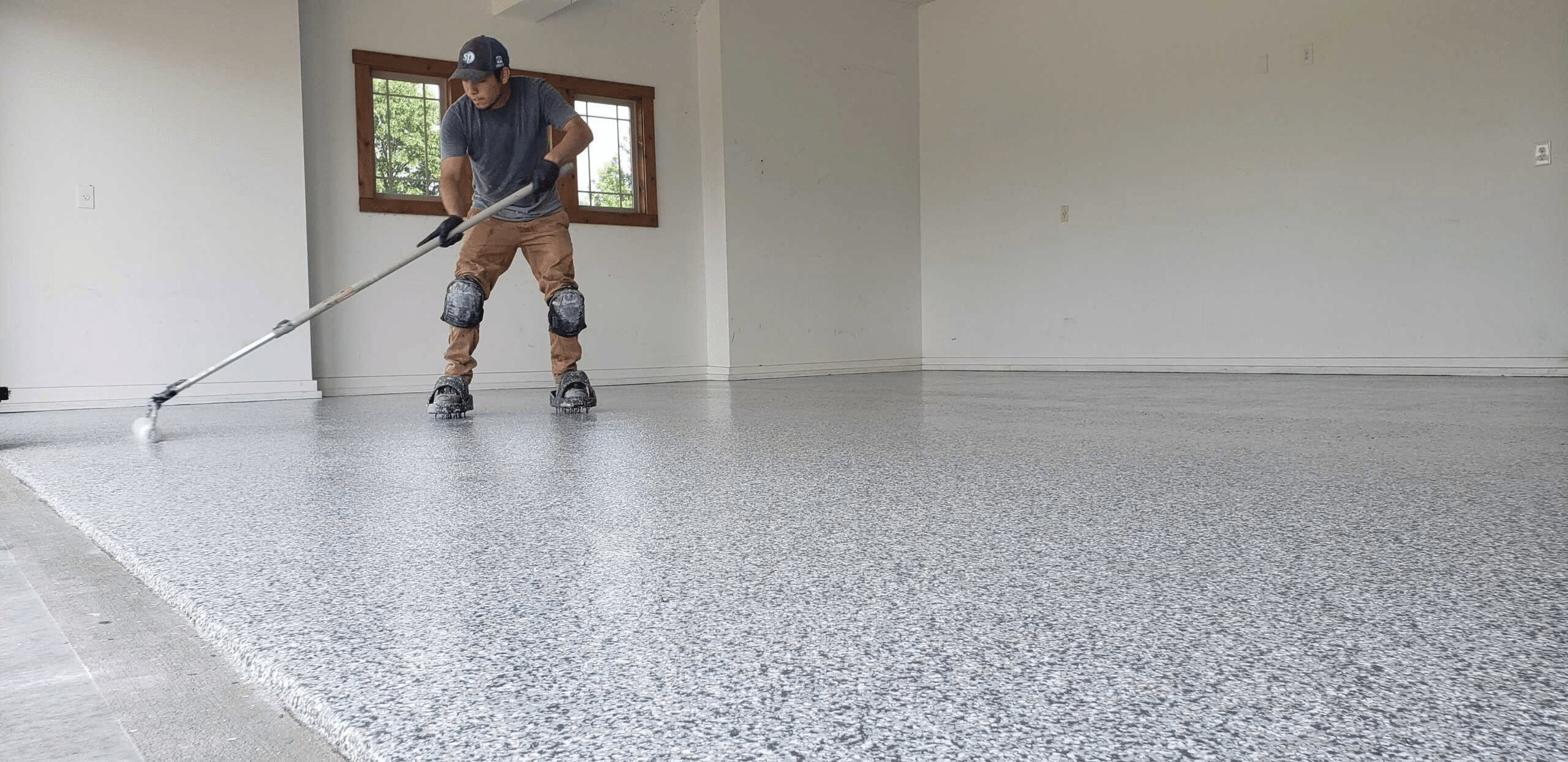
What Polyurea Garage Floor Coating Actually Is
Polyurea is a two-component, fast-curing protective coating made from polyurea polymers that forms a seamless, flexible surface over concrete. The chemistry is fundamentally different from epoxy, and the differences matter for your garage.
The Basic Chemistry
A polyurea coating system bonds chemically to itself in layers and physically to the concrete substrate beneath. It cures in minutes rather than hours, which is why professional installations can typically have you walking on the floor in 4 to 6 hours and parking on it within 24.
The system can be used as a stand-alone coating or paired with a polyaspartic topcoat, which is the most common residential configuration.
How Polyurea Differs From Epoxy
Polyurea is approximately 4 times stronger than epoxy in tensile strength and offers significantly higher elongation, which means it resists cracking under thermal cycling and impact loading.
Where epoxy is rigid and brittle once cured, polyurea stays flexible enough to follow concrete movement through Kansas City freeze-thaw cycles. That single property is why polyurea outperforms epoxy in cold-climate garages.
The Science Behind Different Polyurea Types
Not all products marketed as polyurea are the same. Three chemistries dominate the residential garage market, and the differences affect everything from price to UV durability.
Aromatic Polyurea
Aromatic polyurea is the original chemistry: fast-curing, durable, and inexpensive. The catch is that aromatic polyurea is not UV-stable and yellows or fades when exposed to sunlight.
If your garage has windows, a glass door, or gets indirect UV exposure through the open garage door, aromatic polyurea will lose color and gloss within a few years.
Aliphatic Polyurea
Aliphatic polyurea is engineered specifically for UV stability. It costs more upfront but maintains color and gloss in garages with natural light exposure.
For Lee’s Summit garages with windows or south-facing doors, aliphatic is the right specification.
Polyaspartic (a Polyurea Subtype)
All polyaspartics are technically polyureas, but polyaspartics have been modified to have stronger carbon bonds and a longer working time. They offer the best UV stability and color retention of the three.
The premium residential garage system in most Kansas City metro installations is a polyurea base coat paired with a polyaspartic topcoat. The base coat delivers fast cure and substrate bond; the topcoat delivers UV stability and finish quality.
Why Polyurea Demands Professional Installation
Three properties of polyurea make it fundamentally hostile to DIY installation. Skipping any of them creates the failures you read about in homeowner reviews.
The Fast-Cure Problem
Standard polyurea has a working time of 10 to 30 minutes from mix to set. If the material is not applied to the surface inside that window, it begins to thicken in the roller or sprayer and creates lap marks, lifted edges, and adhesion failures.
Clear topcoats compound the problem because you cannot visually track which areas have been coated and which have not. Professional installers use specialized equipment and lighting to manage this.
Moisture Testing Requirements
The single most common cause of polyurea coating failure is moisture in the concrete substrate at the time of application. Concrete that fails moisture testing creates blisters, delamination, and complete coating failure within months.
Quality contractors run ASTM moisture tests before application and confirm levels under 3 to 5 lbs per 1,000 sq ft per 24 hours, or below 75% to 85% relative humidity depending on the product specification. For why these failures show up as bubbles in the finished coating, see our guide on what causes concrete floor coating bubbles.
Why DIY Kits Often Fail
DIY polyurea kits sold at home improvement stores produce a measurable percentage of failed installations because the chemistry is intolerant of common DIY shortcuts.
Etching concrete instead of grinding does not produce enough surface profile for the coating to grip. Skipping moisture testing means the homeowner discovers the failure point after the coating is already failing. Running long on the working time produces visible lap marks that cannot be corrected without complete removal.
Critical Quality Factors to Review
Three factors decide whether a polyurea installation holds for 15+ years or fails in 18 months. All three are completely within the installer’s control.
Surface Preparation Standards
Industrial-grade products including polyurea require complete focus on substrate preparation. Quality installers use diamond grinding to mechanically profile the concrete, removing the laitance layer and opening the pores so the coating can bond permanently.
Acid etching does not produce enough surface profile for polyurea. Any installer quoting polyurea who plans to acid etch instead of grind is the wrong installer.
Bond Strength and the Lee’s Summit Climate Factor
According to NOAA Kansas City climate data, Lee’s Summit experiences roughly 100 freeze-thaw cycles annually. That thermal cycling stresses the bond between coating and concrete more than warmer-climate garages experience.
Standard polyurea cures so quickly that the coating sometimes does not have time to penetrate the concrete pores for a deep mechanical bond. Polyaspartic topcoats and polyurea-polyaspartic hybrid systems address this with longer working windows.
UV Degradation in Garages
UV stability matters even in garages that look enclosed. Garage door openings, side door windows, and reflected sunlight all expose the floor to UV.
The average garage door cycles roughly 1,500 times per year, each cycle letting UV reach the floor. Aliphatic polyurea or polyaspartic topcoats prevent the yellowing that aromatic polyurea suffers under that exposure.
Cost Analysis and Value Considerations
A clear cost picture and a realistic lifespan comparison are what separate a good buying decision from a bad one.
What You Will Actually Pay
A professionally installed polyurea or polyurea-polyaspartic floor coating runs $6 to $10 per square foot in Lee’s Summit. For a typical 2-car garage of 400 to 500 square feet, that works out to $2,400 to $5,000; for a 3-car garage, $4,800 to $7,800.
For the deeper breakdown of why polyaspartic and epoxy systems carry different price points, see our guide on epoxy vs polyaspartic cost comparison.
Long-Term Value Math
Quality polyurea or polyaspartic systems last 10 to 20 years in residential garages. Quality epoxy installs last 5 to 10 years.
Across a 20-year ownership period, the polyurea premium often pays back through avoided reinstalls. For why this comparison matters versus painting the concrete instead, see our guide on concrete coating vs garage floor paint.
What Drives Price Variation
Three variables shift the final price meaningfully: concrete condition (cracks, spalling, and moisture remediation add labor), product tier (aromatic polyurea is cheapest, polyaspartic is most expensive), and decorative customization (flake systems, custom colors, or metallic finishes add 10% to 25%).
Making an Informed Decision
Three factors decide whether you get the coating you paid for or a repair project in disguise.
Questions to Ask Contractors
Ask which specific polyurea chemistry the contractor uses (aromatic, aliphatic, polyaspartic, or hybrid), how they prepare the substrate (grinding or etching), what moisture testing they run before application, what their working-time discipline looks like, and what the warranty actually covers (adhesion failures versus wear-through). Contractors who answer all five questions clearly are the ones worth shortlisting.
When Polyurea Is the Right Pick (and When It Is Not)
Polyurea or polyaspartic is the right pick for Lee’s Summit garages that see heavy use, road salt, hot tire lift problems with epoxy, or UV exposure through windows and doors.
Epoxy may still be the right call for low-use garages where budget is the dominant constraint. For the broader pattern of what goes wrong with residential garage coatings of all types, see our guide on common garage floor coating problems.
Timing the Project
Polyurea requires surface temperatures above 50°F and below 90°F during application, plus low humidity for proper cure. Lee’s Summit weather windows for ideal installation run roughly mid-April through mid-October.
For the seasonal breakdown of why timing matters in the Kansas City metro, see our guide on the best time to install garage floor coating.
Your garage floor takes the worst Kansas City weather has to offer year-round, and the wrong coating choice creates a 3-year liability instead of a 15-year asset. Whether you want an honest assessment of whether polyurea or polyaspartic fits your Lee’s Summit garage specifically, advice on the moisture testing and surface prep your concrete actually needs, or a full professional installation that holds for 15+ years through freeze-thaw and road salt, our team at Select Coatings will walk you through exactly what your garage needs.
Call 913-349-6689 for a FREE estimate today.
